Fire Truck Checks: A Daily, Weekly, and Monthly Apparatus Checklist
A practical fire truck check checklist: what to inspect at the start of every shift, every week, and every month, what the standards expect, how to handle failed items, and how to stop missed and pencil-whipped rig checks.
Every firehouse has a truck check sheet.
Most of them live on a clipboard in the cab, and most of them have the same problem. The boxes get checked. The truck doesn't always get checked.
A low tire gets written down and never reported. The saw that wouldn't start last Tuesday still won't start. The SCBA cylinder at the officer's seat has been at 3,800 psi for a week because nobody wanted to be the one to swap it. And when somebody asks for proof the ladder was checked before it went out of service, the answer is a binder.
A truck check is only worth doing if it finds problems and gets them fixed. This guide gives you a practical daily, weekly, and monthly checklist for fire apparatus, explains what the standards expect, and shows how to make sure a failed item turns into a repair instead of a checkmark.
Quick answer: Check fire apparatus at the start of every shift (or daily for staffed stations), with a longer check weekly and a deeper one monthly. A daily check covers a walk-around, tires, fluids, warning lights and siren, air brakes, the pump and tank, SCBA, radios, EMS equipment, and the equipment inventory. Weekly checks start and run the generator, saws, fans, and rescue tools. Monthly checks cover documented SCBA inspections, extinguishers, ground ladders, and expiration dates. Every failed item should become a tracked deficiency with an owner, and serious failures should take the unit out of service.
Use this as a starting point, not a substitute for your manufacturer's manual, your department's policies, or the current edition of the NFPA standards. Your apparatus manufacturer decides how fluids are checked and how often parts are serviced.
What the Standards Expect
You don't need to memorize standard numbers, but you should know where the rules come from.
- NFPA 1910 covers the inspection, maintenance, testing, and retirement of in-service fire apparatus. Its 2024 edition absorbed the old NFPA 1911, and it includes a chapter on daily and weekly visual and operational checks, including documenting them.
- Your manufacturer's manual sets the specifics: how to check each fluid, which items need service at what interval, and what the warning lights mean.
- OSHA's respirator rule says SCBA kept for emergency use must be checked for proper function before and after each use and inspected at least monthly, with the monthly inspection documented. Our fire department inventory guide covers every SCBA date in detail.
- NFPA 10 calls for monthly inspections of portable fire extinguishers, including the ones on your apparatus.
NFPA has been folding many older standards into new, consolidated ones, so ask for the current edition rather than the number you remember. And whatever your rules say, a check that isn't written down didn't happen, as far as an auditor, an insurer, or an investigator is concerned.
The Daily Truck Check
This is the start-of-shift check, done every day at a staffed station. Departments with low-use apparatus often run it weekly and after every call instead. Either way, it should take a crew about 15 to 30 minutes per apparatus once it's routine.
Walk-around
- Body, compartments, and doors closed and latched, with no new damage
- No fresh leaks under the apparatus: oil, coolant, fuel, hydraulic fluid, or air
- Mirrors clean and adjusted, windshield and wipers in good condition
- Ground ladders, hard suction, and roof equipment secured
Tires and wheels
- Tire pressure, tread depth, and sidewalls, with no cuts, bulges, or exposed cords
- Lug nuts present, with no signs of loosening such as rust trails or shifted indicators
- Nothing lodged between the duals
Fluids
- Engine oil, coolant, transmission fluid, and power steering fluid, checked the way your manufacturer says (some are checked hot or running)
- Fuel at or above your department's minimum. Many departments refuel at three-quarters of a tank.
- Diesel exhaust fluid (DEF) level on newer engines
Cab, lights, and warning devices
- Dash warning lights clear after start-up, and gauges reading normal
- All emergency lights, headlights, turn signals, brake lights, and scene lights working
- Siren, air horn, and backup alarm working
- Seat belts working at every seat
Air brakes
- Air pressure builds to normal within the time your manufacturer specifies
- Low-air warning works
- Parking brake holds
- Air tanks drained if your apparatus needs it
Batteries and charging
- Shoreline or battery charger disconnected (or set up to eject) before the apparatus moves
- Battery voltage normal, with no warnings
Pump and tank
- Water tank full and foam tank at its level
- Pump engages and builds pressure, if your policy calls for a daily pump check
- Pressure governor or relief valve working, and drains and discharges closed
- Intake and discharge caps in place
SCBA
- Every seat's SCBA function-checked: cylinder pressure, regulator, facepiece, and PASS alarm
- Cylinders at your department's minimum. OSHA expects a recharge when pressure falls to 90 percent of the manufacturer's recommended level.
- Spare cylinders full and secured
Radios and electronics
- Portable radios charged and spare batteries ready
- Mobile radio and mobile data terminal working
- Thermal imaging camera charged
- Gas monitors bump-tested as often as the manufacturer requires. Many call for a bump test before each day's use.
EMS equipment
- AED self-test indicator showing ready, with pads in date
- Oxygen cylinder pressure at or above your minimum
- Jump bags sealed, or restocked and resealed if they were opened
Equipment inventory
- Hand tools, nozzles, appliances, and hose loads where they belong
- Anything used on the last call cleaned, restocked, and put back
Weekly Checks
Once a week, add the equipment that only shows a problem when you run it.
- Generator and scene lighting: start it, put it under load, and check fuel and oil.
- Saws and fans: start and run each one, then check fuel, chains, and blades.
- Hydraulic or battery rescue tools: operate them, check fluid or battery charge, and look over the hoses and tips.
- Hose loads: look for wear and make sure couplings aren't stuck in place.
- Pump: operate every valve and drain, and flush the pump if your department or manufacturer calls for it.
- Batteries: look over the terminals and cables for corrosion.
- Cleaning: wash the apparatus and clean the cab. Dirt hides damage and leaks.
Monthly Checks
Monthly checks are where documentation matters most, because these are the inspections people ask to see.
- SCBA inspection, documented for every pack: date, inspector, findings, any repair needed, and the unit's serial number.
- Portable fire extinguishers on the apparatus: in place, charged, sealed, and tagged.
- Ground ladders: look over rails, rungs, halyards, pawls, and labels for damage, and check that the heat sensor labels haven't changed color.
- Compartment inventory against the master equipment list for that apparatus, item by item.
- Expiration dates on medications, EMS supplies, and anything else with a date. Our inventory guide covers par levels and expiration tracking.
- Grease points and other monthly service items your manufacturer lists.
Annual Testing
Some tests aren't crew checks at all. They're done by trained technicians or outside testing companies, usually at least once a year:
| What | Who usually does it |
|---|---|
| Fire pump service test | Fleet staff or a testing company |
| Aerial device inspection and testing | A qualified inspector |
| Ground ladder service test | A testing company or trained staff |
| Fire hose service test | Trained crews or a testing company |
| SCBA flow test | A trained SCBA technician |
| Extinguisher annual maintenance | A certified technician |
Your daily, weekly, and monthly records feed these. When the pump tester asks about the pump's history, you want the answer to be a report, not a guess.
When an Item Fails
This is where most truck check programs break down. The failure gets written on the sheet, the sheet goes in the binder, and nothing happens.
A failed item should become a deficiency, and a deficiency needs five things:
- A severity. Is it minor, does it need repair soon, or does it take the unit out of service?
- An owner. One person responsible for getting it fixed, not "the mechanic" or "B shift."
- A due date. So nobody can lose track of how long it's been open.
- Photos and a note. "Outrigger drifts down when stowed, hydraulic leak at the jack cylinder" gets fixed faster than "outrigger bad."
- A status until it's closed. Acknowledged, in progress, waiting for parts, ready for service, resolved.
Write down which failures take a unit out of service so nobody has to make that call alone at 7 a.m. Brake or steering problems, an air system that won't build pressure, major fluid leaks, and failed warning lights are common examples. Start from your manufacturer's guidance and NFPA 1910.
And when the unit comes back, record the repair: what was done, the work order number, and the cost. That history is what tells you when a truck is costing more to keep than to replace.
Make the Check a Crew Job
One person doing the whole check every morning is how checks get rushed and skipped. Split the work:
- The driver/operator takes the walk-around, fluids, tires, brakes, and pump.
- The officer takes radios, the computer, and a final look at the open deficiencies.
- Firefighters take SCBA, EMS equipment, tools, and the compartment inventory.
When everyone logs into the same check, it gets done faster, and you can see who still owes what.
Paper Sheets vs. Software
Paper works until you need to answer one of these questions:
- Which trucks didn't get checked this week?
- How long has that deficiency been open?
- Which item fails most often across the fleet?
- Can you prove the ladder was checked before it went out of service?
Software answers them without a binder search. It also does what paper can't: reminds the crew before a check goes overdue, flags readings outside their limits automatically, attaches photos to failures, and tells the right people the moment a unit goes out of service.
8 Things to Look For in Apparatus Check Software
- Checklists you build yourself, with sections, pass/fail items, readings with limits, quantities, and required notes on failures.
- Schedules that match reality: daily, weekly, monthly, and longer, with as-needed checks after calls.
- Missed checks that get flagged, to the officers who need to know, before and after they're overdue.
- Failures that become tracked repairs, with severity, photos, an owner, a due date, and an out-of-service flag.
- A readiness board that shows every unit as ready, behind, deficient, or out of service.
- A phone-friendly runner that works in the apparatus bay, with barcode scanning and photos.
- SCBA and PPE checks by seat and by member, not just by truck.
- Reports and exports for audits, insurance, and budget requests.
For the bigger picture on department software, see our Fire Department Software Buyer's Guide.
Where Station Clipboard Fits
Station Clipboard Checklists handles truck checks, SCBA inspections, and PPE checks for fire and EMS crews.
Build your checks once. Add sections and items with six answer types: check, quantity, readings with automatic pass/fail limits, date, text, and choice. Require a note on failures. Then schedule each check daily, every N days, weekly, monthly, quarterly, twice a year, or yearly, with open and due-by times, plus as-needed runs after a call. A check can cover the whole department, each apparatus, or each member for PPE.
Every unit's status on one board. The readiness board shows each apparatus as ready, behind, deficient, or out of service, with what's due today and the open alerts beside it.
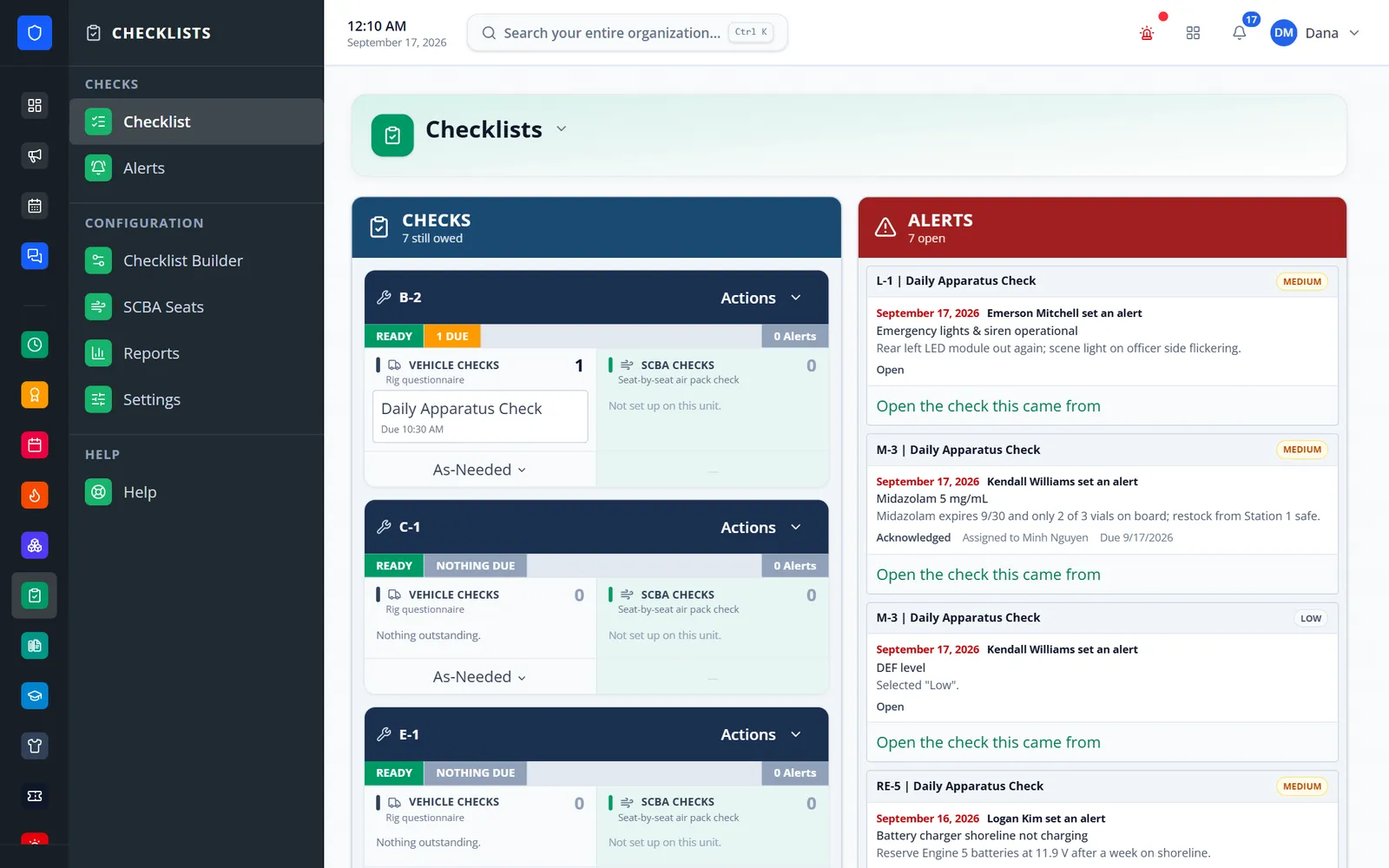
Every unit's checks and open deficiencies on one board, with out-of-service units called out.
The whole crew works the same check. Members log items in batches from a phone, scan a barcode to jump to an item, and add notes and photos to failures. If the signal drops in the bay, answers are queued and sent when the connection returns (photos need a connection). SCBA checks go seat by seat, with pack, cylinder, and facepiece checks, PSI readings, and air-fill logging.
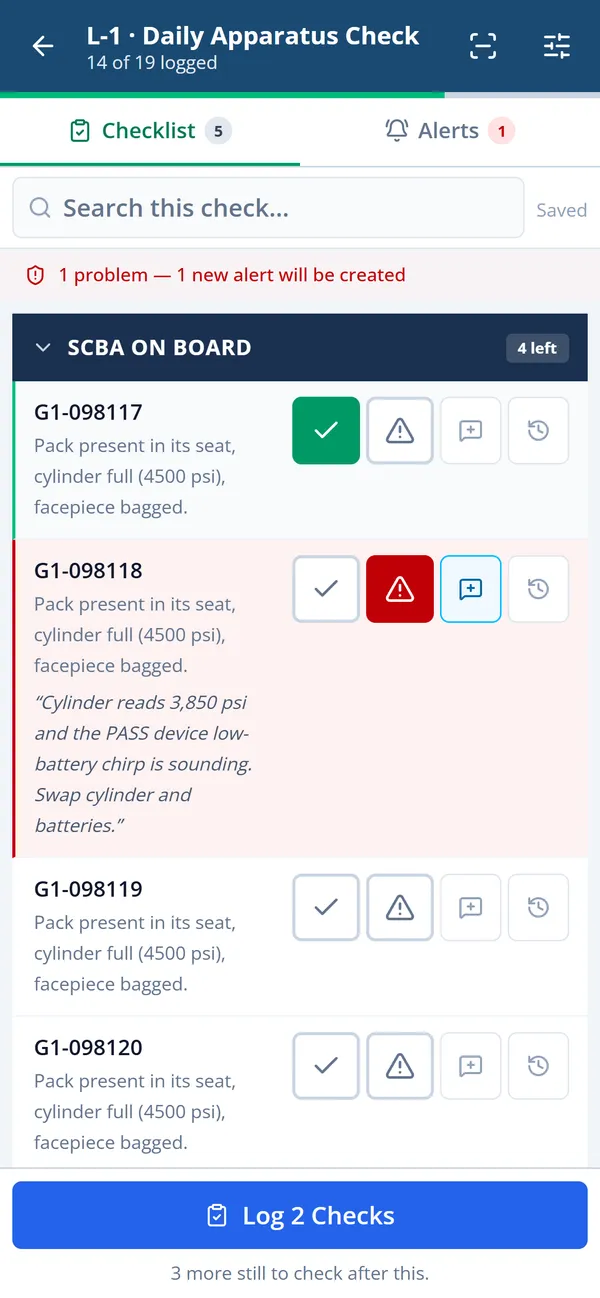
Run checks from the apparatus bay with big pass and fail buttons.
Failures become repairs. A failed item becomes an alert with a severity, up to 10 photos, an out-of-service flag, an owner, and a due date. It moves from acknowledged to in progress, awaiting parts, and ready for service, with a work order reference and cost, and it keeps notifying until it's handled.
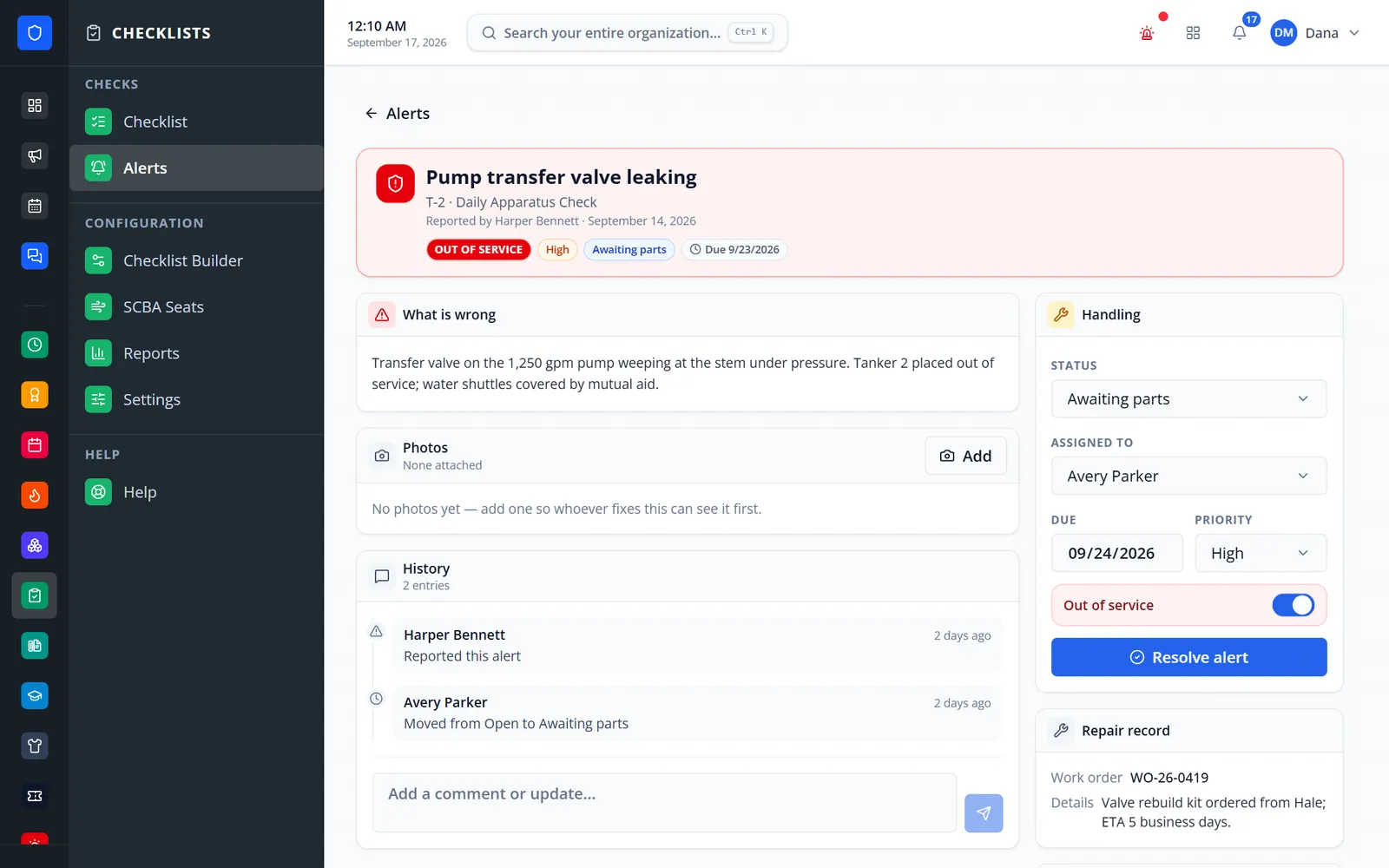
Out-of-service status, owner, due date, work order reference, and a running history.
Proof when you need it. Missed checks are flagged to the roles you choose, and on-duty members can be warned before a check goes overdue. Checklist versions can't be changed after the fact, every completed check keeps its snapshot, and you can add claimed checks, supervisor review, or a typed-name attestation. Compliance reports show the compliance rate and trend, completed and missed checks by day, alert aging, and the most frequent failures, with CSV and PDF exports.
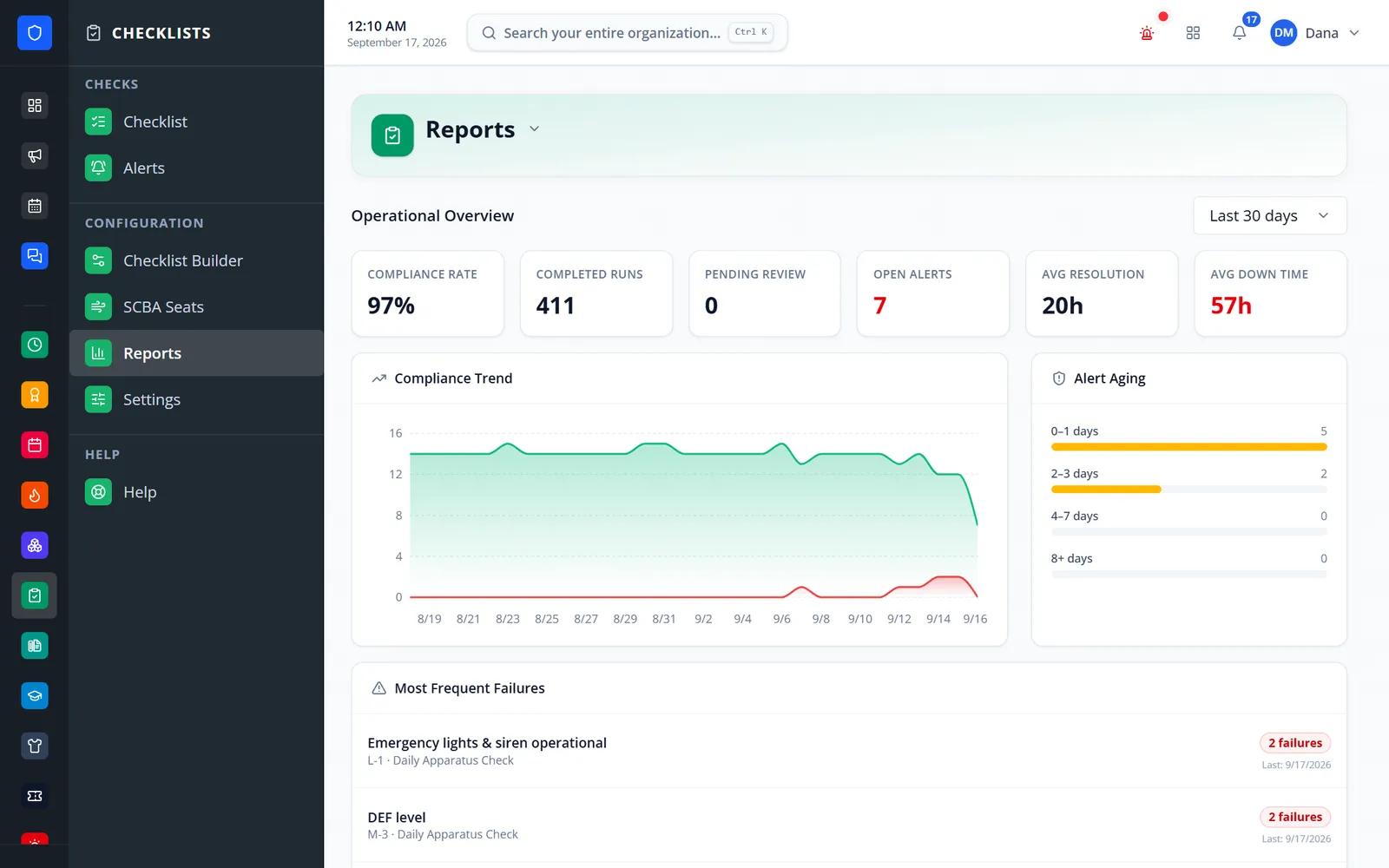
Compliance rate, missed checks, alert aging, and the items that fail most.
It also works with the rest of the Department Portal:
- With Assets turned on, checks can target your apparatus and equipment records, write results into their history, and mark units out of service.
- With Quartermaster turned on, a check item can report supply shortages, which go to an officer for review before stock changes.
For setup details, start with these Help Center guides: Build and schedule a checklist, Run an apparatus check, and Work checklist alerts to resolution.
Want to see your own truck check in Station Clipboard? Contact us, send us your current check sheet, and we'll walk through it with you.
Frequently Asked Questions
How often should fire trucks be checked?
Most departments check staffed apparatus at the start of every shift or every day, with longer checks weekly and monthly. Low-use apparatus is often checked weekly and after every call. NFPA 1910 includes daily and weekly visual and operational checks, and your manufacturer's manual sets the specific service intervals.
What should be on a daily fire truck check?
A daily check usually covers a walk-around for damage and leaks, tires and wheels, fluid levels and fuel, dash warning lights, emergency lights and siren, air brakes, batteries, the pump and water tank, SCBA at every seat, radios and electronics, EMS equipment, and the equipment inventory in each compartment.
Who should do the daily apparatus check?
The whole crew. A common split is the driver/operator checking the truck itself, fluids, tires, brakes, and pump, the officer checking radios and open deficiencies, and firefighters checking SCBA, EMS equipment, and tools. Splitting the check makes it faster and less likely to be skipped.
What NFPA standard covers fire apparatus inspections?
NFPA 1910 covers the inspection, maintenance, testing, and retirement of in-service emergency vehicles. Its 2024 edition absorbed NFPA 1911, which used to cover in-service fire apparatus, and it includes daily and weekly visual and operational checks.
What should happen when an item fails a truck check?
The failure should become a tracked deficiency with a severity, an owner, a due date, a note, and photos, and it should stay open until it's repaired. Failures such as brake, steering, or air system problems should take the unit out of service under a written policy.
How long should fire department truck check records be kept?
Follow your state's records retention schedule and your department's policy. Many departments keep apparatus inspection and maintenance records for the life of the vehicle, because they show its history when it's tested, sold, or involved in an incident.