Fire Department Inventory Management: A Quartermaster's Guide to Gear, PPE & SCBA
A practical guide to fire department inventory management in 2026, from quartermaster stock by size and issued gear to turnout gear under NFPA 1850, SCBA and cylinder testing, supplies, and grant property records.
Ask a quartermaster how many medium uniform shirts are on the shelf, and the honest answer is usually "let me go look."
Ask who still has the turnout coat issued to the member who left in March, and the answer gets longer.
Most fire department inventory lives in four places at once. A gear closet with handwritten tags. A spreadsheet only one officer can edit. A binder of SCBA inspection sheets in the bay. And the memory of whoever has been quartermaster the longest. That works until a size runs out the week before a recruit class, a cylinder misses its hydrostatic test, or a grant monitor asks to see your property records.
Fire department inventory management isn't really about counting things. It's about knowing who has what, what's due, and what has to be replaced, before somebody needs it. This guide covers how to set that up: stock by item and size, issued gear, turnout gear under the new NFPA 1850, SCBA and cylinder testing, supplies, grant-funded equipment, and what to look for in quartermaster software.
Quick answer: Fire departments should manage inventory in one system that tracks uniforms and gear by item and size, records every item issued to a member with the date and issuer, and alerts the quartermaster when a size runs low. Turnout gear and SCBA need serialized records with manufacture, inspection, testing, and retirement dates. Under NFPA 1850, structural turnout gear is retired no more than 10 years after it was made, gets an advanced inspection at least every 12 months, and gets advanced cleaning at least twice a year. SCBA are inspected at least monthly and flow tested at least once a year, and each cylinder follows its own hydrostatic test schedule.
This article explains standards and regulations in plain English. It isn't legal or compliance advice. Check the current edition of each standard, and always follow your gear and SCBA manufacturers' instructions.
Five Kinds of Fire Department Inventory
"Inventory" means different things in a fire station. Trying to keep all of it on one list is why the spreadsheet breaks.
| Inventory | Examples | Track it by | What you need to know |
|---|---|---|---|
| Uniforms and issued gear | Station uniforms, jackets, work boots, badges, hoods, gloves | Item and size | What's on the shelf, who has what, and what to reorder |
| Turnout gear | Coats, pants, helmets | Serial number | Who it's issued to, when it was made, inspections, cleaning, and retirement |
| SCBA | Packs, cylinders, facepieces | Serial number | Monthly inspections, flow tests, hydrostatic tests, and cylinder life |
| Supplies and medical stock | Medications, airway supplies, cleaning supplies | Item, lot, and location | Par levels and expiration dates |
| Apparatus equipment | Tools, saws, hose, radios | Serial number or compartment | Where it lives, its condition, and its service schedule |
Some items cross over. Hoods and gloves are usually stocked by size like uniforms, but they're still part of the protective ensemble, so the same retirement rules apply to them.
The first group is classic quartermaster work. Turnout gear and SCBA are life-safety equipment with deadlines set by standards and regulations. The last two are logistics. Keep them in one system, but give each kind the record it needs.
Quartermaster Basics: Stock by Item and Size
The quartermaster's job is to have the right gear, in the right size, when a member needs it, and to know where all of it went.
Track every size as its own item
"Twenty shirts" isn't useful. Twenty shirts in XL and none in medium is a problem. Good quartermaster inventory tracks each size separately, with its own count and its own SKU or barcode.
Set a low-stock level for each size
Large and XL move faster than XS. Set the reorder point per size, not per item, so the alert comes when the size you actually burn through runs low.
Decide who can get what
Not every member needs every item. Probationary members might get station uniforms but not a dress uniform, and only officers get collar brass. Set eligibility by role up front, so members only see and ask for what they can get, and the quartermaster stops turning down the same requests.
Put requests in one queue
Requests that arrive by text, in the hallway, and on sticky notes get lost. One queue, where a member picks the item, size, and quantity and the quartermaster approves it or rejects it with a reason, gives everyone the same answer.
Record every stock change
Every add, issue, return, and adjustment should keep who made it and why. When the count is off, that history tells you where to look.
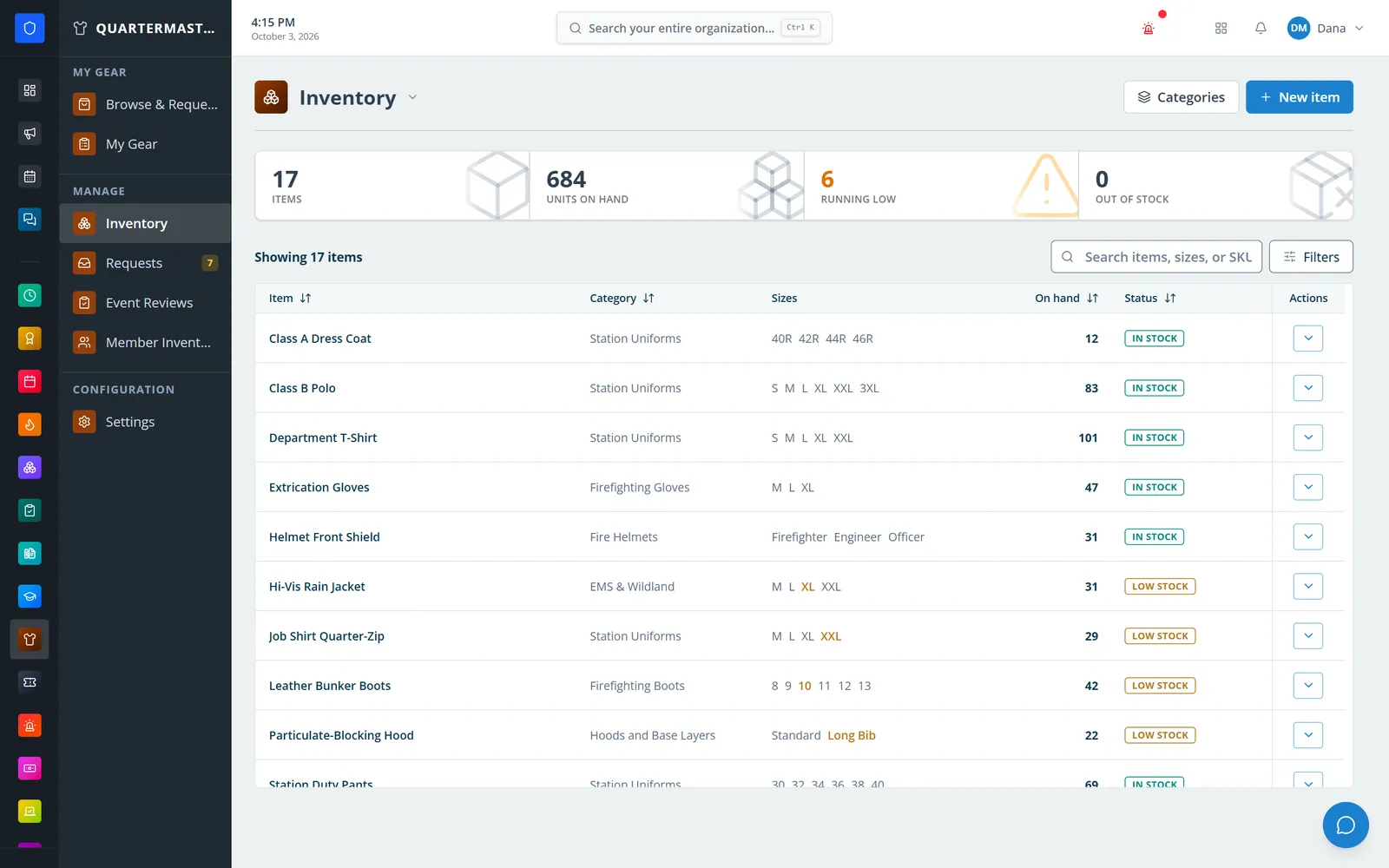
Every item with its sizes and on-hand count, and low-stock sizes highlighted.
Who Has What: Tracking Issued Gear
The most expensive inventory problem isn't running out. It's losing track of gear that has already been handed out.
Every issued item should record who received it, when, and who issued it. That record pays off three times:
- When a member leaves. You know exactly what to collect. Without a record, the coat, helmet, and radio that walked out the door are just gone.
- When gear is recalled or retired. Finding every member who holds a specific item is a search, not a phone tree.
- When a member asks for more. You can see what they already have before you approve another jacket.
Make issuing part of onboarding. Collect sizes when a new member joins, so their gear is ready on day one instead of three weeks later. And make returns part of separation: go through the member's issued list, mark what came back, and decide whether each item goes back on the shelf or out of service.
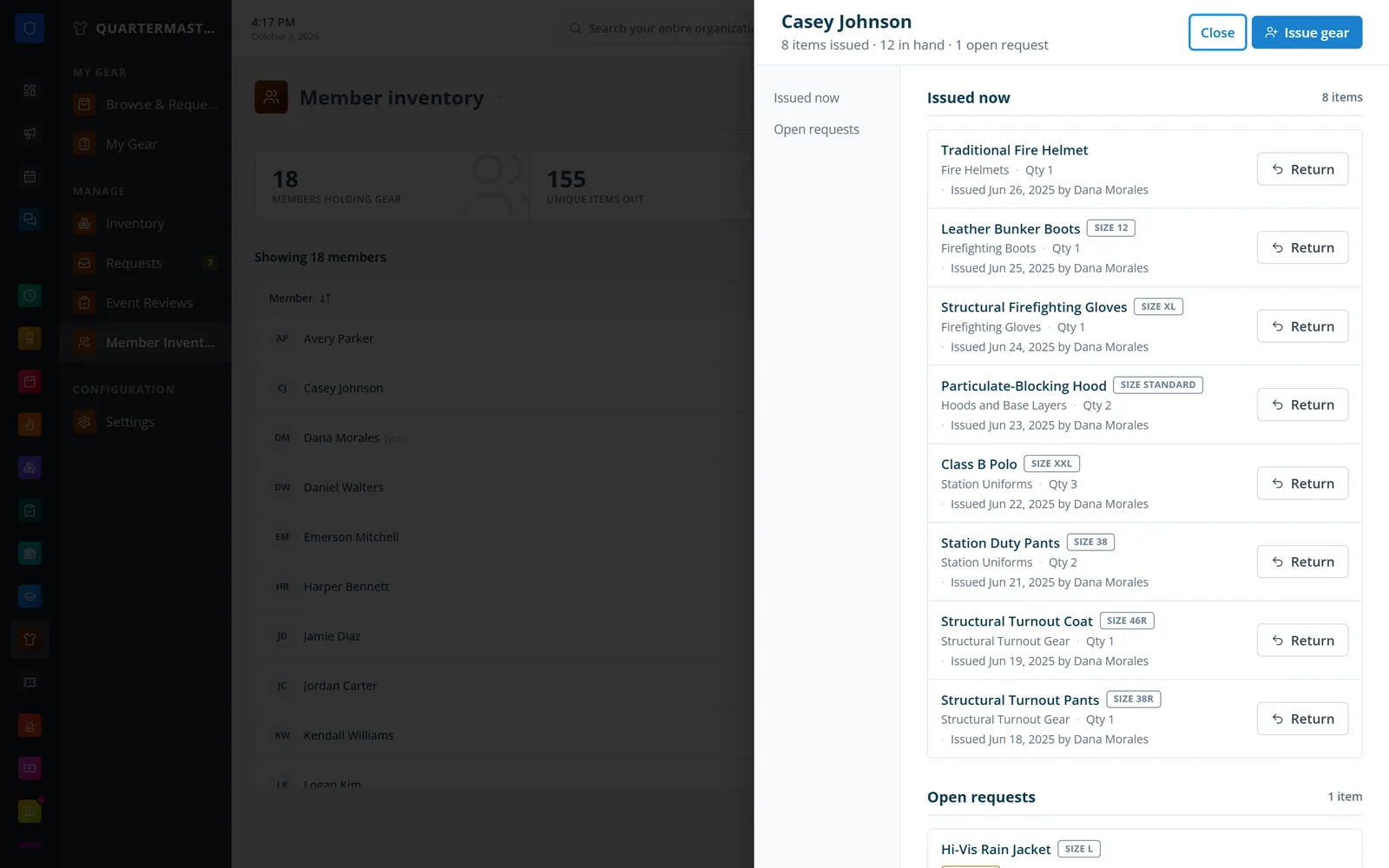
One member's issued gear, with the issue date, who issued it, returns, and open requests.
Turnout Gear Under NFPA 1850
Structural turnout gear isn't a uniform. It's protective equipment with a defined service life, and it needs its own record.
NFPA 1850 replaced NFPA 1851 and NFPA 1852
NFPA 1850 combines the old NFPA 1851 (selection, care, and maintenance of protective ensembles) and NFPA 1852 (the same for SCBA) into one standard. The current edition is dated 2026 and took effect on September 9, 2025. The turnout gear portion gave departments one year to train members on the changes, so if your gear SOPs still cite NFPA 1851, it's time to update them.
The rules that drive your inventory
| NFPA 1850 rule | What it means for your records |
|---|---|
| Retire gear no more than 10 years after its manufacture date | Record the manufacture date of every coat, pants, helmet, hood, glove, and boot. The clock keeps running while gear sits unissued in storage. |
| Advanced inspection at least every 12 months | Log the date, who inspected it, and what they found, by serial number. |
| Advanced cleaning at least twice a year | Track cleanings per item, plus extra cleanings after contamination. |
| Routine inspection after each use | Members check their own gear. A recurring per-member PPE check makes it visible. |
| Advanced cleaning before new gear is issued | The standard recommends it, so build it into how new gear goes into service. |
| A PPC Manager and PPC Technician | Name the people who own the protective clothing program and its records. |
What to keep for every piece of gear
At a minimum, each element of the ensemble should have a record of:
- Who it's issued to, and when.
- Manufacturer details: make, model, serial number, size, and manufacture date.
- Every inspection, cleaning, and repair, with dates and results.
- When it was retired, and how it was disposed of.
Those records are the backbone of an NFPA 1850 gear program. You'll also need them if gear fails in normal use, because NFPA 1850 now requires departments to report those failures to the manufacturer and the certification organization.
Plan replacements before they're due
The 10-year rule turns gear replacement into a schedule you can see years ahead. Sort your turnout gear by retirement date, and next year's budget request mostly writes itself. Hoods and gloves rarely last 10 years in regular use, so plan to replace them sooner.
Spare gear ages too. Because the clock starts at manufacture, a spare set bought "just in case" loses service life on the shelf. Rotate spares into use instead of saving them.
SCBA: The Inventory With the Most Deadlines
SCBA carry more dates than anything else in the station, and each component keeps its own. A cylinder moves from pack to pack, and its hydrostatic test date goes with it. That's why SCBA should be tracked by component, with a serialized record for each pack, cylinder, and facepiece.
| What | How often | Where the rule comes from |
|---|---|---|
| Check function | Before and after each use | OSHA, 29 CFR 1910.134(h)(3) |
| Inspect | At least monthly | OSHA, 29 CFR 1910.134(h)(3) |
| Keep cylinders charged | Recharge when pressure falls to 90% of the manufacturer's recommended level | OSHA, 29 CFR 1910.134(h)(3) |
| Flow test | Before first use, at least once a year, and after repairs | NFPA 1850 (formerly NFPA 1852) and the manufacturer |
| Fit test | Before first use, at least once a year, and whenever a member changes facepiece size, style, model, or make | OSHA, 29 CFR 1910.134(f)(2) |
| Hydrostatic test | Usually every 5 years for carbon composite and aluminum cylinders, and every 3 years for some older fiberglass-wrapped cylinders | DOT, per the cylinder's markings |
| Cylinder retirement | Usually 15 years after manufacture for composite cylinders. Aluminum cylinders have no fixed life while they keep passing tests. | DOT, per the cylinder's markings |
| SCBA retirement | Depends on the edition the SCBA was certified to and any approved upgrades, up to about 20 years | NFPA 1850 and the manufacturer |
A few details matter more than they look:
- The cylinder's markings decide. The specification or special permit marked on each cylinder sets its test interval and service life. Record it along with the manufacture date and the last test date. Some composite cylinders can be requalified past 15 years under a DOT special permit, but check with your SCBA manufacturer before you count on it.
- The monthly inspection has to be documented. For respirators kept for emergency use, OSHA expects a record of the date, the inspector's name or signature, the findings, any required fix, and the serial number or other ID of the unit. A tag on the unit works, and so does an electronic record.
- Retired SCBA must be destroyed or made unusable. Record the retirement date and how the unit was disposed of, so it can never quietly return to service.
Federal OSHA rules apply directly to private employers. Public fire departments fall under them in states with an OSHA-approved State Plan, and many departments in other states follow 1910.134 as their respiratory protection program anyway.
Supplies and Medical Stock: Par Levels and Expiration Dates
Consumables don't need serial numbers. They need par levels, lot numbers, and expiration dates, tracked where the stock actually lives: on each apparatus and in each station's supply room.
- Set a par level per location. Medic 1 and Engine 2 don't carry the same stock.
- Record lot numbers on medications. When a recall comes in, you need to find that lot in minutes.
- Get reminded before things expire, early enough to move stock to a busier unit instead of throwing it out.
- Let checks report shortages, but review them before they change stock. A rig check is the best time to catch a missing item. An officer should still approve the change, so one mistyped number doesn't throw off the whole count.
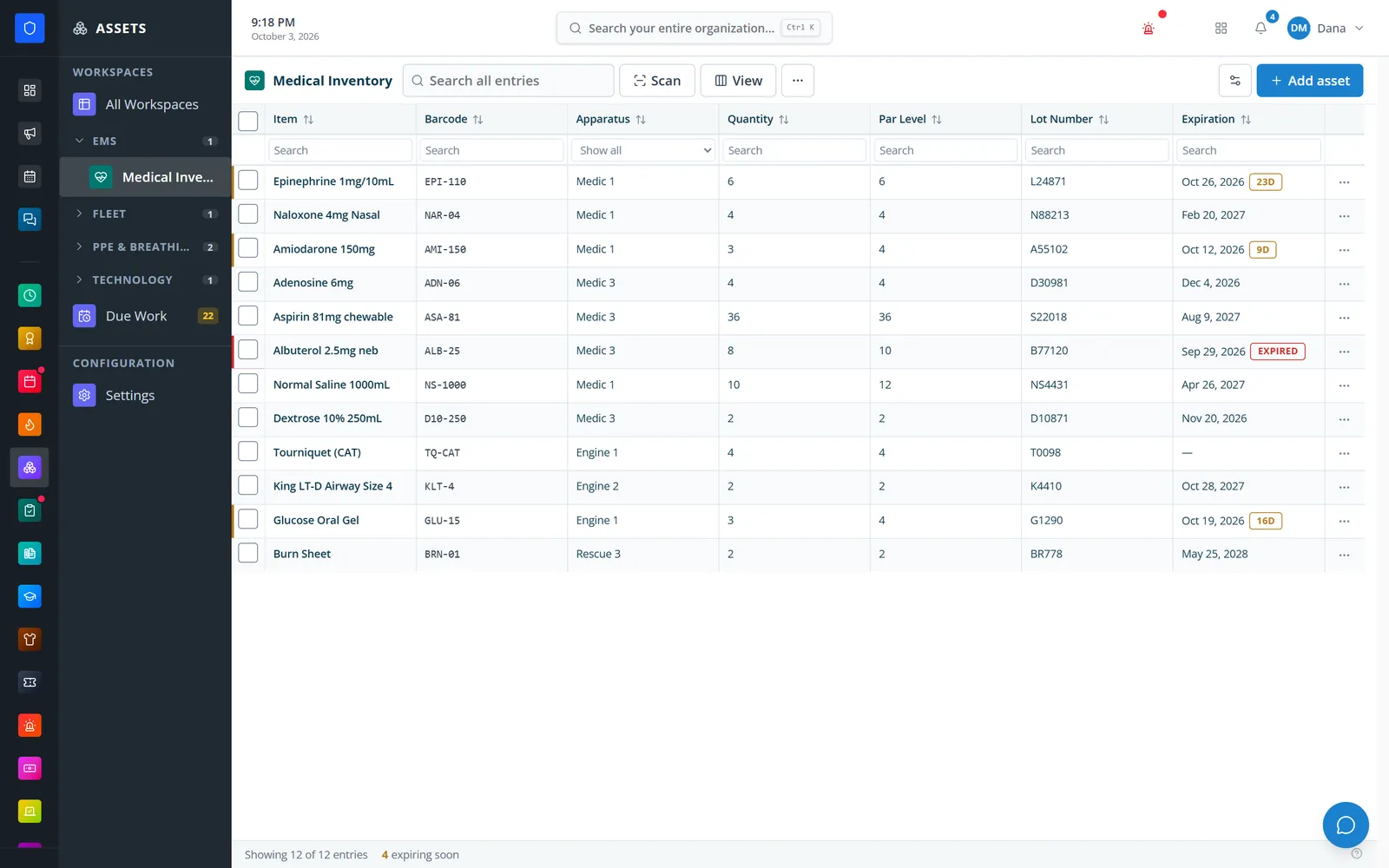
Drugs and supplies by unit, with lot numbers, par levels, and expired items flagged.
Checks Keep Inventory Honest
A count once a year tells you what went wrong. Daily, weekly, and monthly checks catch problems while they can still be fixed.
- Daily or per-shift apparatus checks confirm equipment is where it belongs and working.
- Monthly SCBA checks, seat by seat, cover the pack, the cylinder pressure, and the facepiece.
- Per-member PPE checks make routine gear inspection visible instead of assumed.
A failed item shouldn't end as a checkmark on paper. It should become a deficiency with an owner, a due date, and an out-of-service flag when it's serious, and it should stay open until someone fixes it. Our Fire Department Software Buyer's Guide covers what to look for in check software.
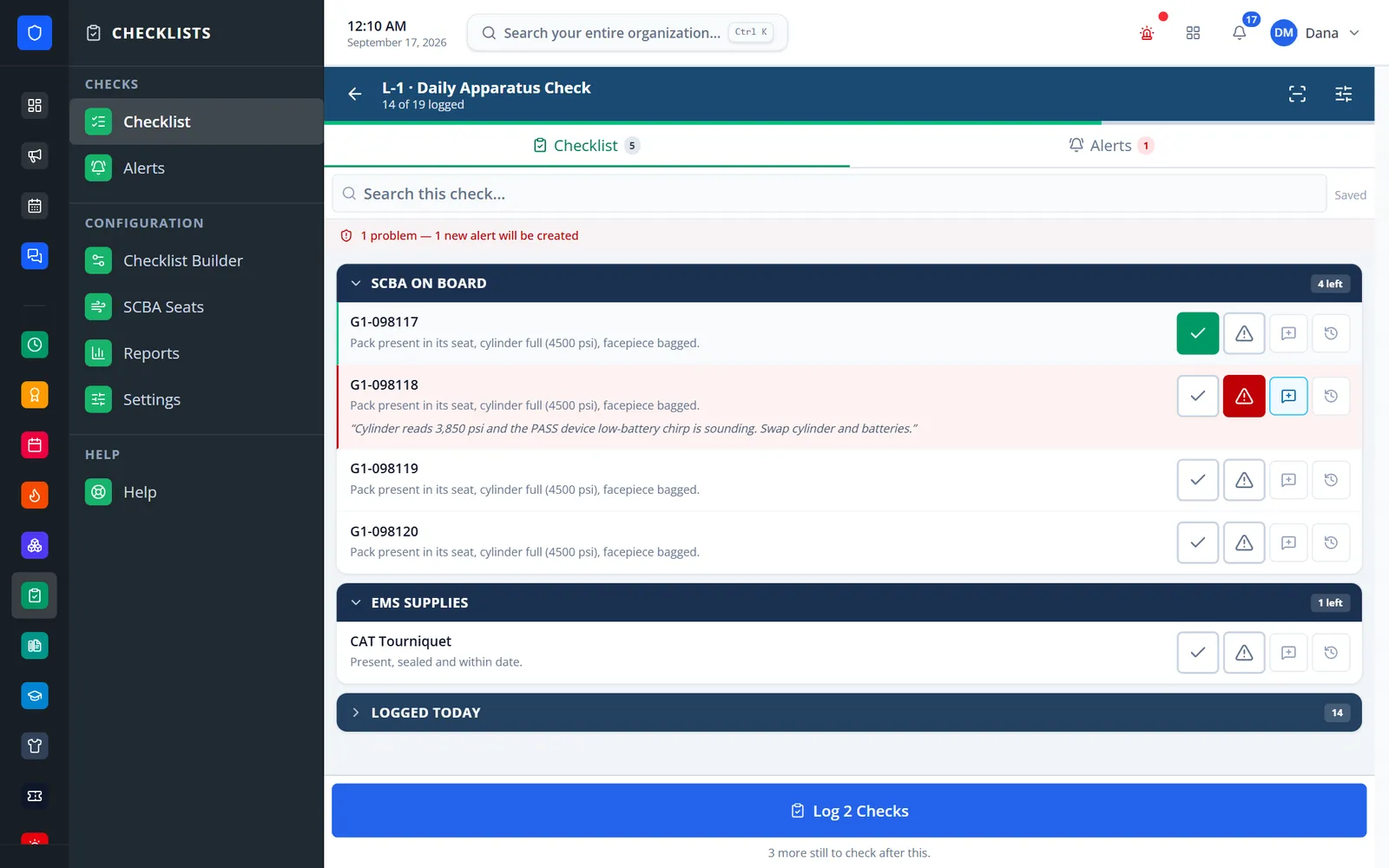
Readings carry their limits, and a failed item with a note becomes an alert.
Grant-Funded Equipment Has Its Own Rules
Many departments buy SCBA and turnout gear with federal grants such as the Assistance to Firefighters Grant (AFG). Federal awards come with property rules in 2 CFR 200.313 that your inventory has to support.
- Property records must include a description, a serial number or other ID, the funding source (including the federal award number), who holds title, the acquisition date and cost, the federal share of that cost, the item's location, use, and condition, and disposal details once it's gone.
- A physical inventory must be taken and reconciled with those records at least once every two years.
- What counts as equipment: for awards made on or after October 1, 2024, items with a useful life of more than one year and a per-unit cost of at least $10,000, or less if your department's own capitalization threshold is lower.
Missed two-year inventories are a common grant audit finding. If your inventory system already stores serial numbers, locations, conditions, and dates, the count is a walk-through with a scanner instead of a project. Our fire department grants guide covers the application side.
10 Things to Look For in Quartermaster and Inventory Software
Use this as a checklist when you compare tools.
- Stock by item and size, with a SKU and a low-stock alert for every size.
- Issued gear per member, with the issue date, the issuer, and returns.
- Role-based eligibility, so members only see and request what they can get.
- One request queue where requests are approved, rejected with a reason, or canceled.
- Barcode scanning with a phone camera or a USB scanner, with no special hardware required.
- Serialized records with your own fields for manufacture, inspection, test, and retirement dates.
- Expiration reminders that reach the right people before a date passes.
- Recurring maintenance that calculates the next due date for every record.
- Checks tied to the equipment, so a failed SCBA or PPE check lands on that item's record.
- A full history, a CSV import for your existing spreadsheet, and exports for audits.
And one login for all of it. Inventory software that's separate from your roster, onboarding, and training means re-entering every new member and every departure. For the bigger picture, see our Fire Department Software Buyer's Guide.
How to Move Off the Spreadsheet
1. Count what you have
Do one full count before you build anything. It's the baseline everything else gets checked against.
2. Build the catalog by size
Start with the items you issue most. Add the rest as they come up.
3. Load turnout gear and SCBA first
They carry the deadlines, so they're worth entering first. Import your existing spreadsheet instead of retyping it.
4. Confirm what members already hold
Have each member confirm their issued gear. It's the fastest way to find the coat nobody remembers issuing.
5. Use the barcodes you already have
Most gear and SCBA components already carry a manufacturer barcode or serial label. Try those before you print your own.
6. Turn on requests and retire the old way
Once requests have a home, stop taking them by text.
7. Set reminders and schedules
Add reminders for retirement dates, hydrostatic tests, and flow tests, and schedule your monthly SCBA checks.
Where Station Clipboard Fits
Station Clipboard covers fire department inventory with three modules that share one login, one roster, and one set of roles.
Quartermaster: uniforms and gear by size
Quartermaster organizes gear into categories, items with pictures, and sizes that each carry their own SKU, on-hand count, and low-stock threshold. Limit an item to specific roles, and members without those roles won't see it. Members browse what they're eligible for, see whether it's in stock, and request a size and quantity from their phone.
The quartermaster approves requests or rejects them with a reason. To hand out gear, scan labels with a USB scanner at the desk or a phone camera, or pick sizes from the list, and Issue gear issues several items to a member at once. Issuing gear a member asked for approves their request. Every add, subtract, adjustment, issue, and return goes into a stock ledger with who and why, and returns can go back on the shelf or not. When a size drops to its threshold, the people who manage stock get an action-required notification. Members see everything signed out to them on My Gear.
Assets: turnout gear, SCBA, and supplies
Assets gives you equipment workspaces built from templates. The SCBA template tracks packs, cylinders, facepieces, regulators, and RIC/UAC kits by serial number, with cylinder size, rated pressure, assignment, status, manufacture and in-service dates, last hydrostatic test and hydrostatic test due, last flow test and flow test due, cylinder retirement date, and last fit test. The Turnout Gear & PPE template tracks coats, pants, helmets, hoods, gloves, and boots by serial number, with size, assigned member, condition, manufacture date, last advanced inspection, and retirement date. Medical Inventory tracks lot numbers, par levels, and expiration dates by unit.
Expiration fields send reminders at the thresholds you choose, recurring maintenance calculates the next due date for every record, and Due Work lists everything overdue or coming due across workspaces. Find any record with a phone camera or USB scanner, bring in your existing spreadsheet with a CSV import you review before anything is saved, and export any workspace to CSV. With 19 field types, you can add your own fields too, like the grant that paid for a pack.
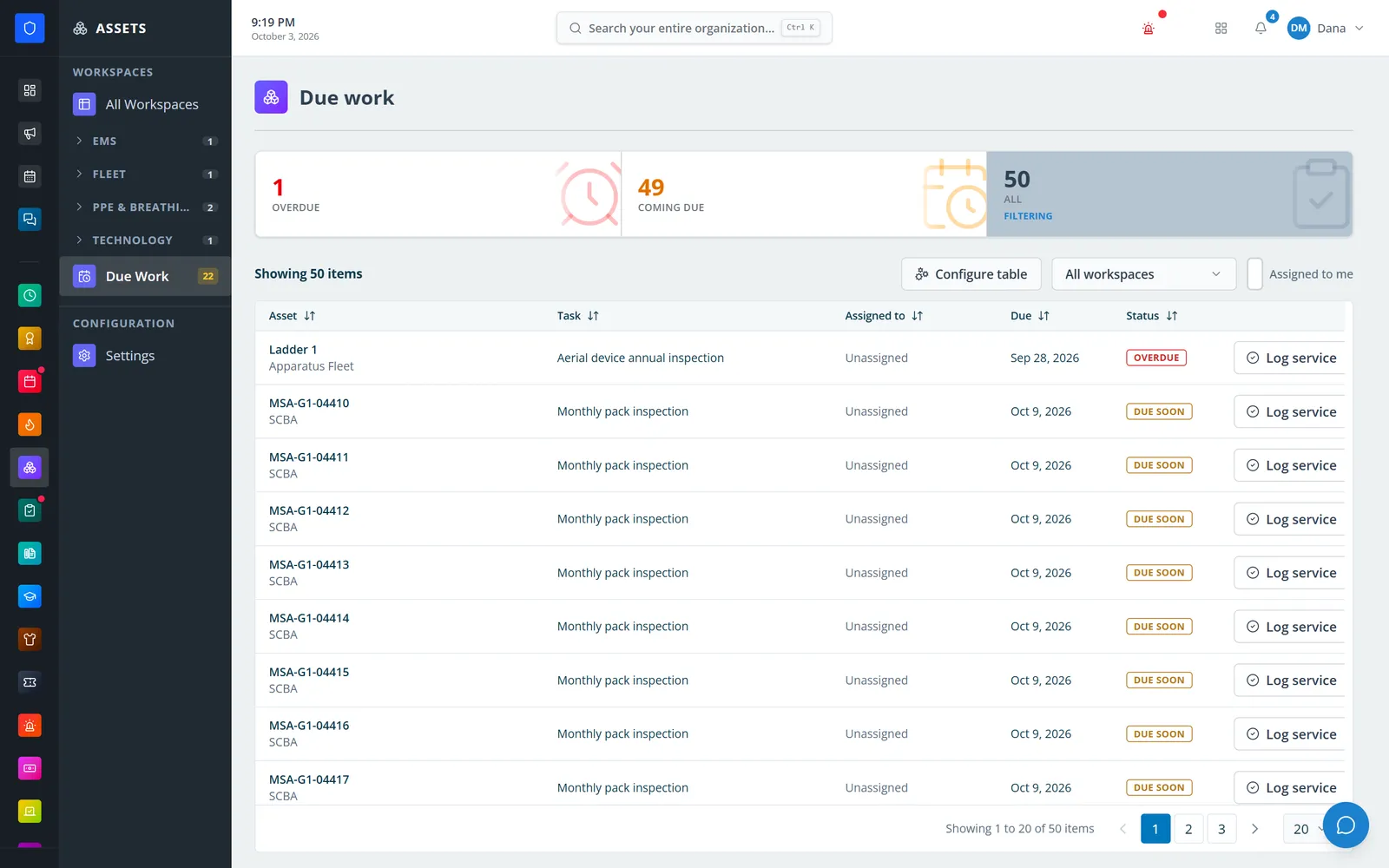
Overdue and coming-due service across every workspace, with Log service on each line.
Checklists: SCBA, PPE, and rig checks
Checklists runs the checks: seat-by-seat SCBA checks of the pack, cylinder, and facepiece with PSI readings and air-fill logging, a check per member for PPE, and daily truck checks, on schedules from daily to yearly. Failed items become alerts with severity, photos, an owner, a due date, and an out-of-service flag. With Assets on, checks can target workspace records and write their results into each record's history. With Quartermaster on, a supplies check can report shortages and use against a gear size, and those wait in Event Reviews until someone approves them, so stock never changes on its own.
Because it's all part of the Department Portal, Onboarding can have new members pick their gear sizes, which can file Quartermaster requests for them.
For setup details, start with these Help Center guides: Build the Quartermaster catalog, stock, and sizes, Issue, return, and reconcile member gear, Import existing inventory into an Asset Workspace, Configure expiration reminders and recurring maintenance, and Build and schedule a checklist.
Want to see it with your department's own gear? Contact us and we'll walk through it with you.
Frequently Asked Questions
What is fire department inventory management?
Fire department inventory management is how a department tracks its uniforms, protective gear, SCBA, supplies, and equipment: what's in stock, who each item is issued to, and when it's due for inspection, testing, or replacement. Most departments run it through a quartermaster, with software that tracks stock by size and keeps serialized records for turnout gear and SCBA.
What does a fire department quartermaster do?
A fire department quartermaster orders, stores, and issues uniforms and gear to members, keeps stock by size, handles requests and returns, and tracks who has what. In many departments the quartermaster also coordinates turnout gear inspections, cleaning, and replacement.
How long does firefighter turnout gear last?
Under NFPA 1850, structural firefighting turnout gear must be retired no more than 10 years after its manufacture date, even if it sat unused in storage. Gear is retired sooner if an inspection finds damage, and hoods and gloves often wear out well before 10 years.
How often should turnout gear be inspected and cleaned?
NFPA 1850 calls for a routine inspection after each use, an advanced inspection at least every 12 months, and advanced cleaning at least twice a year, plus extra cleaning whenever gear is contaminated.
What replaced NFPA 1851?
NFPA 1850 replaced both NFPA 1851, which covered turnout gear care and maintenance, and NFPA 1852, which covered SCBA. The current edition is dated 2026 and took effect on September 9, 2025.
How often do SCBA need to be inspected?
OSHA's respiratory protection standard requires SCBA kept for emergency use to be checked before and after each use and inspected at least monthly, with each inspection documented. SCBA are also flow tested at least once a year under NFPA 1850 and the manufacturer's instructions.
How often do SCBA cylinders need a hydrostatic test?
Most carbon composite and aluminum SCBA cylinders need a hydrostatic test every 5 years, and some older fiberglass-wrapped cylinders every 3 years. Composite cylinders usually have a 15-year service life. The markings on each cylinder set its exact schedule.
What records do fire departments need for grant-funded equipment?
Under 2 CFR 200.313, property records must include a description, serial number, funding source, title holder, acquisition date and cost, federal share, location, use, condition, and disposal details. Departments must take a physical inventory and reconcile it with those records at least once every two years.
Do you need barcode scanners to track fire department inventory?
Not necessarily. Many inventory systems can scan barcodes with a phone camera, and a USB scanner at the quartermaster's desk speeds up issuing. Manufacturer barcodes and serial labels on gear and SCBA components can often be used without printing new labels.