Firefighter & EMS Shift Schedules: 24/48, 48/96, Kelly, and 24/72 Explained
A plain-English guide to fire and EMS shift schedules: how 24/48, 48/96, Kelly, 24/72, and 12-hour rotations work, what they mean for hours and FLSA overtime, what the sleep research says, and how to build and staff one.
Ask ten firefighters about their schedule and you'll hear something that sounds like a code.
"Twenty-four forty-eight." "Forty-eight ninety-six." "We're on a Kelly." "Four platoon, twenty-four seventy-two."
They all solve the same problem. A station has to be staffed every hour of every day, and nobody can work every hour of every day. The pattern you choose decides how often members commute, how long they're away from home, how tired they are on the second night, how much overtime you pay, and how hard the schedule is to build.
This guide explains the common fire and EMS shift schedules in plain English: how each one works, the math behind the hours, what the sleep research says, how federal overtime rules apply, and how to build and staff a rotation without a spreadsheet.
Quick answer: The classic firefighter schedule is the 24/48: 24 hours on duty, then 48 hours off, with three platoons (A, B, and C) taking turns so the station is never empty. Other common patterns are the 48/96 (two 24-hour shifts back to back, then four days off), the Kelly or "California swing" (on, off, on, off, on, then four days off over a nine-day cycle), and the four-platoon 24/72. Any three-platoon 24-hour schedule averages 56 hours a week. Four platoons average 42. EMS agencies also run 12-hour day and night rotations.
This article explains general rules in plain English. It isn't legal advice. Talk to your department's attorney, HR, or labor representatives before changing a schedule or how you pay overtime.
The Schedules at a Glance
| Schedule | How it works | Avg. hours a week |
|---|---|---|
| 24/48 | 24 on, 48 off. 3 platoons. | 56 |
| 48/96 | 48 on, 96 off. 3 platoons. | 56 |
| Kelly or California swing | Over 9 days: on, off, on, off, on, then 4 off. 3 platoons. | 56 |
| 24/72 | 24 on, 72 off. 4 platoons. | 42 |
| 10/14 | Two 10-hour days, two 14-hour nights, 4 off. 4 platoons. | 42 |
| 12-hour rotations | 12-hour day and night shifts. Usually 4 teams. | 42 |
Look at the last column. The pattern doesn't change how many hours your members work. The number of platoons does.
A station staffed around the clock needs 168 hours of coverage a week for every seat. Split that between three platoons and each one averages 56 hours. Split it between four and each averages 42.
Everything else, 24/48 versus 48/96 versus Kelly, is about how those hours are arranged: how many commutes, how many hours in a row, and how long the break is. That's worth knowing before a schedule debate starts.
How 24-Hour Shifts Work
Many career and combination departments in the US work 24-hour shifts. A shift usually starts at 7 or 8 a.m., when the oncoming crew relieves the crew going off.
Members are assigned to a platoon, also called a shift: A, B, or C on a three-platoon schedule, plus D on a four-platoon schedule. Everyone on a platoon works the same days.
The rotation then repeats forever. If A shift works today, you can work out every day A shift will ever work. That's why a schedule only needs two things to get started: the pattern and an anchor date, which is the first day A shift is on duty.
What changes from department to department is everything layered on top: Kelly days, vacation, trades, sick leave, holdovers, and the relief members who cover all of it.
The 24/48 Schedule
How it works: Work 24 hours, then have 48 hours off. Three platoons rotate, so each one is on duty every third day.
In a typical week, A works Monday, B works Tuesday, C works Wednesday, and A is back on Thursday.
Why departments like it
- It's simple. Everyone understands it, and it's easy to staff.
- No tour runs longer than 24 hours. Nobody works two nights in a row at a busy station.
- Recovery time comes after every shift.
The trade-offs
- A commute every third day. That's more than 120 trips to the station a year, which adds up for members who live far away.
- The first day off often goes to recovery, especially after a busy night, which leaves one real day before the next shift.
- 56 hours a week on average. That's over the FLSA 7(k) overtime threshold unless the department adds Kelly days. More on that below.
The 48/96 Schedule
How it works: Work two 24-hour shifts back to back, 48 hours straight, then have 96 hours (four days) off. Three platoons, six-day cycle.
A works Monday and Tuesday, B works Wednesday and Thursday, C works Friday and Saturday, and A is back on Sunday.
The 48/96 has become popular, especially with departments in the western US, and many others have switched or are debating it.
Why members push for it
- Half the commutes. Members work the same hours with half as many trips to the station. That matters when housing near the station is expensive.
- Four days off in a row, every cycle.
- Half as many shift changes, which means half as many handoffs.
The concerns
- The second 24. At a busy station, the second night of a 48 can be rough, and a tired crew is a safety problem.
- Bigger holes. When someone calls in sick, the gap to cover can be 48 hours instead of 24.
- Family logistics. Two nights away in a row is harder for some households, even with more days at home.
What the research says
The evidence is mixed, and most studies are small. A 2025 study in the International Journal of Environmental Research and Public Health followed 24 firefighters whose department moved from a 24/48 to a 48/96. Sleep measured with wrist trackers improved by three months and held steady at six, and insomnia and depression scores improved too. But it was one low call-volume department, and the authors say more research is needed in busier departments and over longer periods. Other studies have been less favorable, particularly for sleep while on duty.
The practical takeaway: call volume matters more than the pattern. A 48/96 at a station that runs four calls a night is a very different schedule from a 48/96 at a station that runs four calls a week. If you're considering a switch, run it as a trial with an end date, and measure sick leave, overtime, holdovers, and how rested members say they are, before and after.
The Kelly Schedule (and Why Nobody Agrees What It Means)
"Kelly" may be the most confusing word in fire service scheduling, because people use it for two different things.
1. The 9-day Kelly schedule, or "California swing"
Work 24, off 24, work 24, off 24, work 24, then four days off. Three platoons, nine-day cycle.
Here's who is on duty each day of the cycle:
| 1 | 2 | 3 | 4 | 5 | 6 | 7 | 8 | 9 |
|---|---|---|---|---|---|---|---|---|
| A | C | A | B | A | B | C | B | C |
A works days 1, 3, and 5, then has four days off. B and C run the same pattern, each starting three days after the platoon before it. It's the same 56-hour average as a 24/48, arranged so members get a long break every cycle.
2. The Kelly day
In many departments, a Kelly day is an extra scheduled day off dropped into a 24/48 rotation to bring average hours down. Each member skips one regular shift on a set cycle.
The math is simple. If every member takes a Kelly day every seventh shift, they work six shifts out of seven, and their average drops from 56 hours to 48. One Kelly day every 14th shift brings it to 52.
Kelly days aren't free. Somebody still has to fill that seat, so departments that use them carry extra relief members or pay overtime to cover.
Tip: when you compare notes with another department or talk to a software vendor, skip the word "Kelly" and write the pattern out day by day. It saves a lot of confusion.
The 24/72 and Other Four-Platoon Schedules
How it works: Work 24 hours, then have 72 hours off. Four platoons (A, B, C, and D), each on duty every fourth day.
The 24/72 averages 42 hours a week, which is why members like it and budgets don't. Going from three platoons to four means staffing every seat with a third more people.
Because 42 hours a week sits under the FLSA 7(k) overtime threshold, a 24/72 doesn't build overtime into every work period the way a 56-hour schedule does. Departments weigh that against the cost of the extra platoon.
The 10/14 is another four-platoon pattern: two 10-hour day shifts, then two 14-hour night shifts, then four days off. It also averages 42 hours, and no tour is longer than 14 hours.
EMS Shift Schedules
Fire-based EMS usually runs on the fire department's schedule, so medics work the same 24/48, 48/96, or 24/72 as the engine crews.
Third-service and private EMS agencies vary more. Common setups include:
- 24-hour shifts, such as a 24/48 or 24/72, especially on units with lighter overnight call volume.
- 12-hour shifts, which keep busy crews from running all night after running all day. A unit staffed 24/7 with 12-hour shifts usually needs four teams, for example two day teams and two night teams, and averages 42 hours a week.
- Patterns like the Pitman, often called 2-2-3. Over 14 days, a team works two, is off two, works three, is off two, works two, and is off three, so members get every other weekend off.
- Peak-load or "power" shifts, which add a unit for 10 or 12 hours during the busiest part of the day instead of paying for 24-hour coverage the agency only needs for part of it.
A good rule of thumb: the busier the unit, the shorter the shift should be. A 24-hour medic unit that runs all night has a fatigue problem, whatever the pattern looks like on paper.
Volunteer and combination departments
Volunteer departments often don't run a fixed rotation at all. They schedule duty nights, weekend duty crews, sleep-in programs, and on-call blocks, and fill them from member availability. Combination departments often mix the two, with a paid daytime crew on a set schedule and volunteers covering nights and weekends.
For these departments, the hard part isn't the pattern. It's collecting availability from busy volunteers and turning it into a schedule that covers every seat.
Hours, Overtime, and the FLSA 7(k) Exemption
Federal overtime rules shape your schedule more than most people expect, especially if you run a 56-hour week.
Under the Fair Labor Standards Act, public agencies can use the section 7(k) exemption for employees in fire protection. Instead of paying overtime after 40 hours in a week, the department sets a work period between 7 and 28 days, and overtime is owed only for hours above a maximum for that period. Here are some of the maximums from 29 CFR 553.230:
| Work period | Maximum hours before overtime |
|---|---|
| 7 days | 53 |
| 14 days | 106 |
| 21 days | 159 |
| 24 days | 182 |
| 27 days | 204 |
| 28 days | 212 |
Here's what that means for a 56-hour schedule. A 24/48 or a 9-day Kelly puts a member on exactly nine 24-hour shifts every 27 days. That's 216 hours against a 204-hour maximum, so 12 hours of FLSA overtime are built into every work period. On a 48/96, a 24-day work period holds eight 24-hour shifts: 192 hours against 182, or 10 hours of overtime.
That's why departments often choose a work period that lines up with their rotation, so every period has the same number of shifts. It's also why Kelly days exist: they bring the hours back under the maximum.
A few more things to know:
- EMS staff only fall under 7(k) if they're trained in fire suppression, have the legal authority and responsibility to engage in it, and work for a fire department of a municipality, county, fire district, or state. EMS-only employees generally get overtime after 40 hours in a week.
- Sleep time on a 24-hour shift counts as work. Under the 7(k) rules, sleep time can't be excluded from a tour of 24 hours or less. On tours longer than 24 hours, such as a 48, up to 8 hours of sleep per 24 can be excluded, but only by agreement. Calls that interrupt sleep count as work, and if a member can't get at least 5 hours of sleep, the whole sleep period counts. (29 CFR 553.222)
- Volunteers aren't paid by the hour, and how you pay stipends can put that status at risk. Our Fire & EMS Time Clock Guide covers volunteer pay, stipends, and the time records worth keeping.
How to Choose a Schedule for Your Department
There's no best schedule. There's the one that fits your call volume, budget, people, and labor agreement. Work through these questions before anyone votes.
- How busy are your units at night? The heavier the overnight call load, the riskier long tours become.
- How many platoons can you afford? Three platoons means 56-hour weeks. Four means 42-hour weeks and about a third more staff.
- What does every shift need? List the seats: officer, driver or engineer, firefighters, paramedics. A pattern that can't keep a medic on every unit doesn't work, however good it looks.
- How will you cover absences? Vacation, sick leave, training, and Kelly days all need relief. Decide where that coverage comes from before you change the pattern.
- How far do members commute? Long commutes push members toward 48/96 patterns.
- What does your labor agreement say? Schedule changes are usually negotiated, and the work period affects overtime.
- When will training happen? Make sure every platoon can still get together for drills.
If you do change, set a trial period, decide in advance what you'll measure, and put a date on the decision.
How to Build a Shift Schedule, Step by Step
Whatever pattern you choose, building the schedule follows the same steps.
1. Define the seats
Every shift needs a list of positions, the qualification each one requires, and a minimum staffing number. This is the part spreadsheets handle worst, and the part that matters most.
2. Lay down the rotation
Choose the pattern and the anchor date, the first day A shift works, and generate the platoons across the schedule period. Nobody should be counting squares on a calendar.
3. Fill the seats by qualification
Assign members to seats and check each one against their certifications. A missing paramedic or an unqualified driver should show up as a warning before the schedule goes out, not after.
4. Add time off, Kelly days, and relief
Approved vacation and leave should keep members off the schedule, and the holes they leave should be visible right away.
5. Publish, and make sure people saw it
Publish the schedule, notify members, and track who has acknowledged it. "I didn't know I was working" shouldn't be possible.
6. Run changes in one place
Trades, pickups, time off requests, and callouts need one request queue with rules: who approves, hour caps, and no overlapping shifts. If changes happen by text message, the schedule on the wall is wrong by Tuesday.
7. Compare scheduled hours with worked hours
The schedule says who should have been there. The time clock says who was. Comparing the two catches missed shifts, unrecorded holdovers, and overtime surprises before payroll does.
8 Things to Look For in Fire and EMS Scheduling Software
Use this as a checklist when you compare tools.
- A rotation generator for your pattern, including 24/48, 48/96, Kelly, 24/72, 12-hour, and custom cycles, with a preview before anything is created.
- Seats checked against qualifications, so every shift has the officer, driver, and medic it needs.
- Minimum staffing alerts that warn or block before a short schedule is published.
- Availability from a phone, for volunteer and combination departments.
- Trades, pickups, and time off with rules, including hour caps and overlap checks.
- Callout tools that keep a record of who was asked to cover and who answered.
- A connection to the time clock and payroll, so scheduled and worked hours can be compared.
- Exports and a full history of every change, for audits and grievances.
For the bigger picture, see our Fire Department Software Buyer's Guide.
Where Station Clipboard Fits
Station Clipboard Scheduling is fire and EMS scheduling software built around the way departments actually staff shifts.
Rotations take a minute, not an afternoon. Choose Generate from a rotation, pick 24/48, 48/96, 24/72, Kelly (9-day), 12-hour day/night, or a custom cycle, choose one to six platoons, and set Platoon A's first duty day. That day can fall before the schedule period, and the cycle runs back from it. Preview the rotation, then create the shifts as drafts.
Then fill every seat. Schedule Admin shows the week or month as a grid grouped by position, with open seats, unmet requirements, and staffing alerts called out. Officer, driver, paramedic, and other seats are checked against each member's qualifications, and staffing alerts can warn or block at publish. Once the schedule is published, you can see who has acknowledged it.
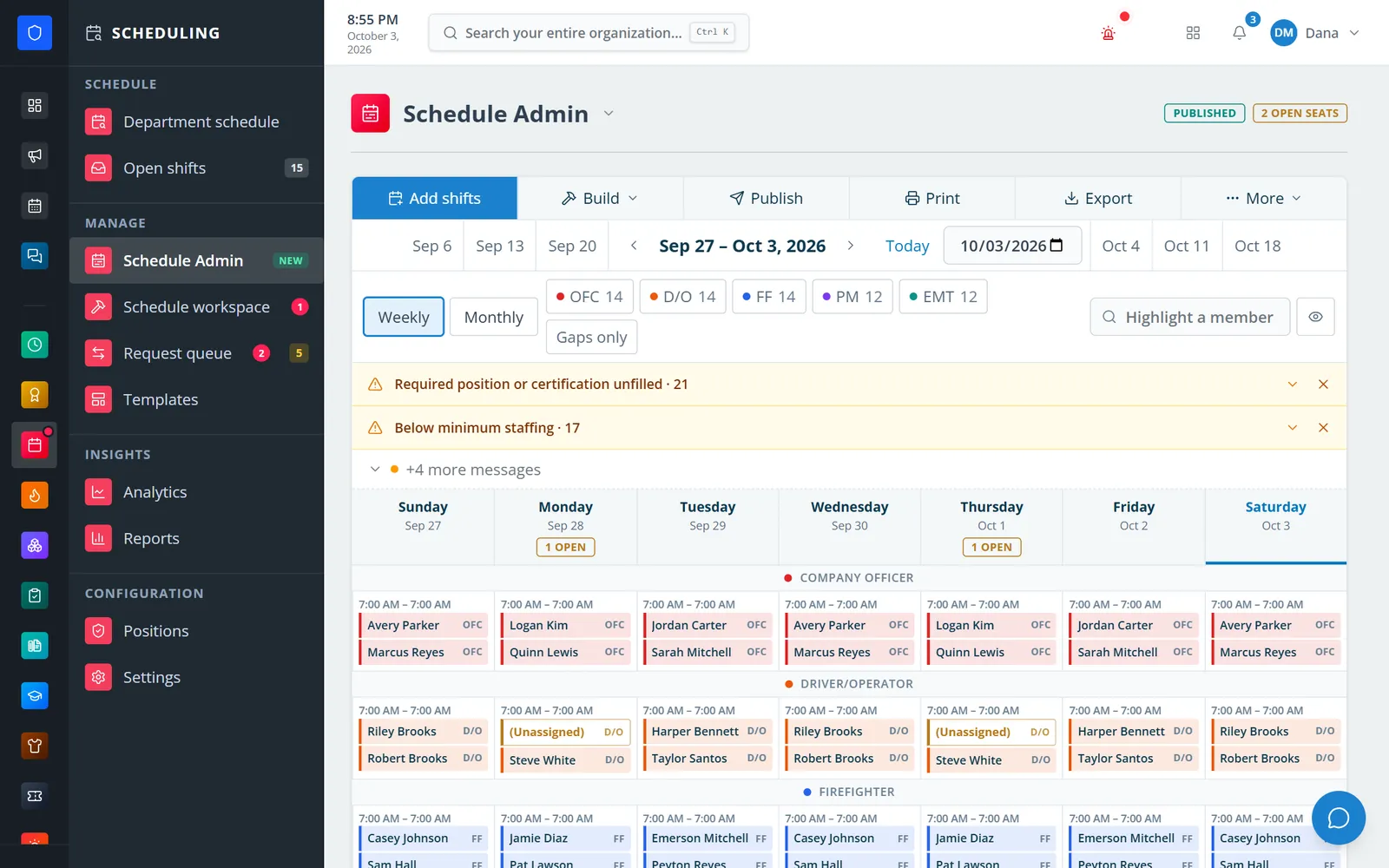
Every seat on every shift for the week, grouped by position, with open seats and staffing alerts called out.
After the schedule is out, members trade with a colleague who accepts, pick up open shifts, and request time off against their leave balances, with overlap and hour-cap checks before approval. When someone calls out, the callout board records who was asked, and a manager widens the search tier by tier, from the station to the whole department. The first qualified member to accept gets the shift.
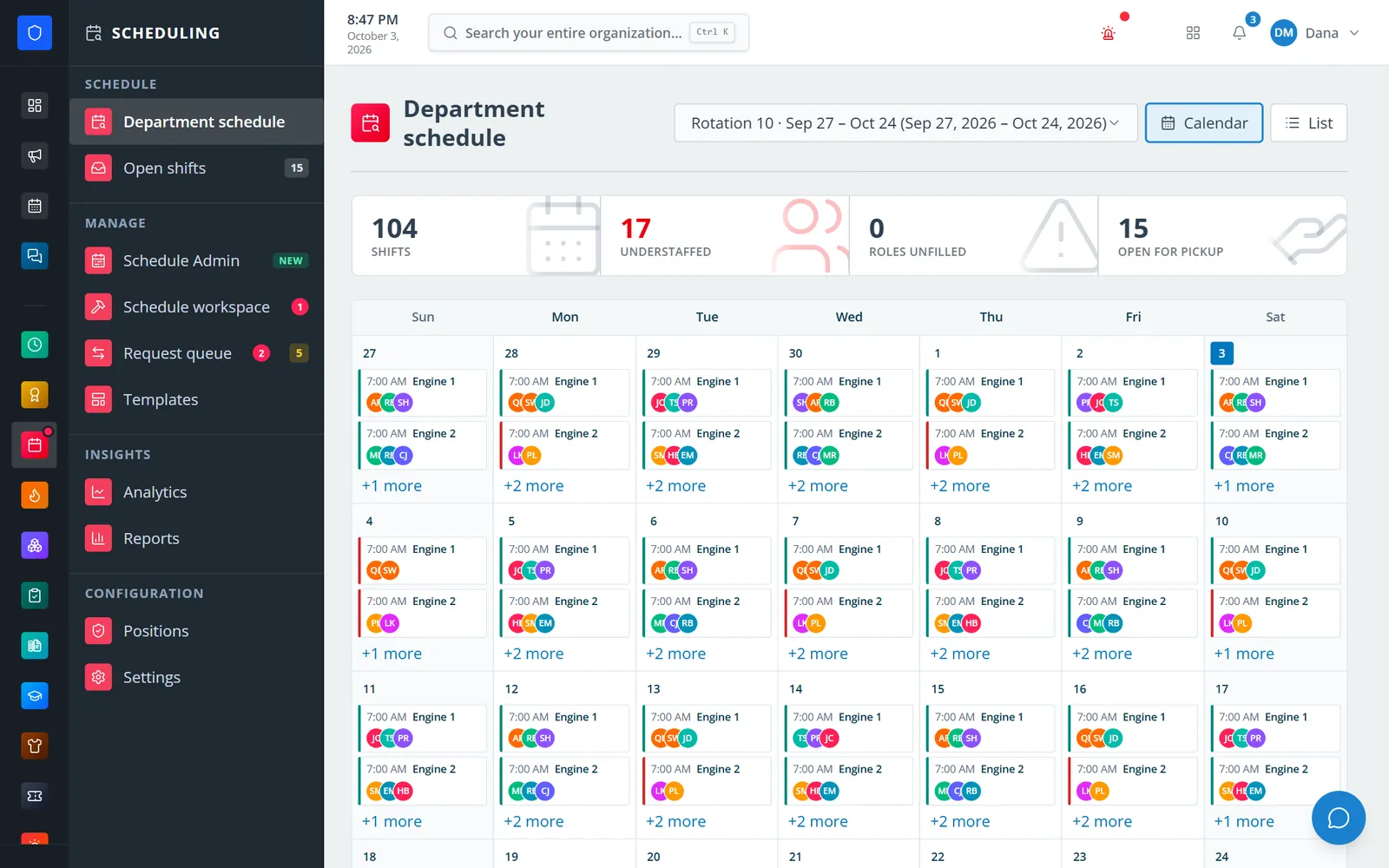
A 28-day rotation at a glance, with understaffed shifts and open shifts counted at the top.
Volunteer and combination departments can open a schedule period and have members mark each shift available, preferred, or unavailable from their phone before a due date. See how that works on our simple department scheduling page.
Because Scheduling is part of the Department Portal, the schedule connects to the rest of the department:
- Time Clock records who actually worked, and Scheduling analytics compare it with who was scheduled.
- Payroll brings completed time entries into a pay period for review, using FLSA 7(k) work periods.
- Station Board can put Today's Schedule and On Duty Now on the station TV.
For setup details, start with these Help Center guides: Create a schedule period and collect availability, Build and publish a certification-aware schedule, and Manage open shifts, trades, time off, and callouts.
Want to see your rotation built in Station Clipboard? Contact us, tell us your pattern and your seats, and we'll walk through it with you.
Frequently Asked Questions
What is the most common firefighter shift schedule?
The 24/48 is the classic firefighter schedule: 24 hours on duty followed by 48 hours off, with three platoons rotating so the station is always staffed. The 48/96 and the 9-day Kelly schedule are also common, and some departments use a four-platoon 24/72.
How many hours a week do firefighters work?
Firefighters on any three-platoon 24-hour schedule, including the 24/48, 48/96, and Kelly, average 56 hours a week. Four-platoon schedules such as the 24/72 average 42 hours. Departments that add Kelly days to a 24/48 can bring the average down to around 48 to 52 hours.
What is a 48/96 schedule?
A 48/96 schedule means working 48 hours in a row, two back-to-back 24-hour shifts, followed by 96 hours (four days) off. It uses three platoons on a six-day cycle and averages 56 hours a week, the same as a 24/48, but with half as many commutes and shift changes.
What is a Kelly schedule?
The term is used two ways. A 9-day Kelly schedule, also called the California swing, is 24 hours on, 24 off, 24 on, 24 off, 24 on, then four days off. A Kelly day is an extra scheduled day off added to a 24/48 rotation to reduce average weekly hours.
What is the difference between a 24/48 and a 48/96?
Both use three platoons and average 56 hours a week. On a 24/48, members work one 24-hour shift and then get two days off. On a 48/96, they work two shifts back to back and then get four days off. The 48/96 cuts commutes in half, but the second 24 hours can be tiring at busy stations.
What shifts do EMTs and paramedics work?
Fire-based EMTs and paramedics usually work the fire department's schedule, such as a 24/48. Third-service and private EMS agencies often use 12-hour day and night shifts, 24-hour shifts on lighter units, or peak-load shifts that add units during the busiest hours.
Do firefighters get overtime on a 24/48 schedule?
Usually, unless the department uses Kelly days. Under the FLSA 7(k) exemption, a 24/48 puts a member on nine 24-hour shifts, or 216 hours, in a 27-day work period, which is 12 hours over the 204-hour maximum. Kelly days can bring hours back under that maximum, and many labor agreements pay more than the federal minimum.
How do you build a firefighter shift schedule?
List the positions every shift needs and the qualification for each, choose a rotation and the first day A shift works, and generate the platoons across the schedule period. Then fill each seat with a qualified member, block approved time off, publish, and manage trades and callouts in one place. Scheduling software can generate the rotation and flag short-staffed or unqualified shifts for you.