Volunteer Retention Starts With Making Service Visible
A practical credit system can give volunteers clearer expectations, meaningful recognition, and another reason to stay engaged.
Fire and EMS departments spend considerable time recruiting new volunteers.
Applications are promoted. Interviews are scheduled. Background checks are completed. Gear is issued. Training begins.
But recruitment is only the beginning.
The more difficult challenge is keeping good people engaged after the excitement of joining begins to wear off.
Research conducted for the National Volunteer Fire Council found that nearly 70% of current department leaders believed their department had a volunteer-retention problem. The same research found that almost half of current volunteers had considered leaving their department at some point.
Those numbers point to a problem that cannot be solved by recruitment campaigns alone.
Departments must also build an experience that gives volunteers clear expectations, visible progress, meaningful recognition, and a sense that their service matters.
That is where a properly designed volunteer credit system can help.
Credits Are Not the Retention Strategy
A credit system will not repair poor leadership, unhealthy department culture, or a lack of communication.
It should not attempt to.
Credits are not the entire retention strategy. They are the visibility layer that supports it.
They help answer questions that are often left unclear:
- What does the department expect from me?
- Am I contributing enough?
- Does anyone notice the work I am doing?
- What do I need to complete before the end of the period?
- Am I still progressing as a member of this department?
Without clear answers, volunteers may not know they are falling behind until an officer contacts them—or until they have already begun disconnecting from the department.
A strong credit system makes participation understandable before it becomes a problem.
Clear Expectations Reduce Frustration
Volunteer members balance department responsibilities with careers, school, families, and other obligations.
They need to know what is expected of them.
The National Volunteer Fire Council’s retention research identified unclear time and participation expectations as one reason current volunteers believe members leave. It also found that many department leaders lacked a clear, measurable approach for defining and tracking retention.
A department may tell members to “stay active,” but that phrase can mean something different to everyone.
Does staying active mean responding to calls? Attending training? Completing duty shifts? Participating in community events? Maintaining certifications?
A credit program turns broad expectations into a visible standard.
For example, a department could establish a quarterly goal and allow members to earn progress through:
- Duty shifts
- Emergency responses
- Department training
- External training
- Public-relations events
- Community service
- Certifications
- Administrative projects
- Other approved department activities
Members can then see exactly what counts, what they have completed, and what remains.
The goal is not to reduce service to a number. The goal is to remove uncertainty.
Recognize the Work That Often Goes Unnoticed
Some department contributions are highly visible. Others happen quietly.
A member may spend hours completing apparatus checks, helping at a community event, attending outside training, supporting recruitment, cleaning equipment, or working on an administrative project.
When only calls or scheduled shifts are recognized, those other contributions can begin to feel invisible.
A flexible credit system allows a department to recognize service across the entire organization—not just the activities that are easiest to count.
That recognition matters.
Volunteer-retention guidance emphasizes that recognition should be specific and personal. General awards can be valuable, but regularly acknowledging what an individual actually accomplished may be more meaningful.
Credits create the record. Department leadership must still provide the human recognition.
That might mean:
- Thanking a member for consistently attending training
- Recognizing someone who completed a difficult certification
- Highlighting members who supported a major community event
- Offering quarterly awards or department incentives
- Privately checking in with someone whose participation has changed
A leaderboard or prize can add energy, but the most important result is showing members that their time has been noticed.
Give Members a Reason to See Their Progress
Progress is motivating when people can actually see it.
A volunteer should not have to ask an officer how many hours, activities, or credits they have completed. They should have access to their own progress.
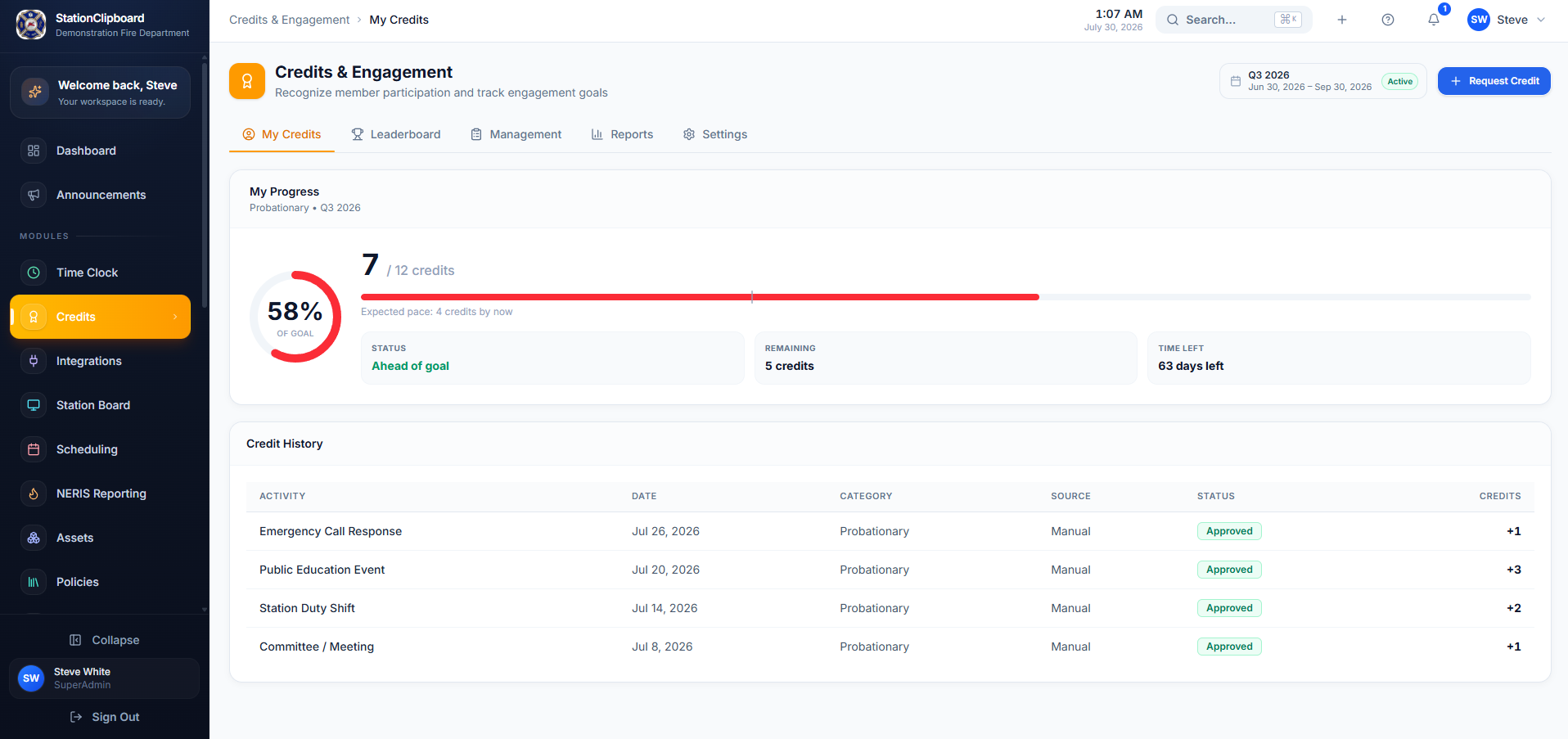
A useful member dashboard should show:
- Current credit balance
- Progress toward the active goal
- Remaining credits
- Completed activities
- Pending requests
- Historical credit entries
- The period deadline
Station Clipboard’s Credits & Engagement module gives each member a personal credit history and progress view while allowing departments to create different goals for volunteers, officers, career personnel, or exempt members.
Departments can use monthly, quarterly, yearly, or custom tracking periods.
This changes credits from an administrative spreadsheet into something members can actively use.
Instead of hearing, “You are behind,” a member can see their own pace and decide what action to take.
That creates personal accountability without requiring constant reminders from officers.
Identify Disengagement Before Someone Leaves
Volunteer disengagement rarely begins with a resignation letter.
It may begin with a missed training.
Then fewer shifts.
Then unanswered messages.
Then the member stops participating altogether.
When activity is scattered across sign-in sheets, spreadsheets, emails, and separate systems, leadership may not recognize the pattern until the member is already gone.
Credit data can provide an earlier signal.
An officer can see which members are below pace, which members have stopped earning credits, or which members have experienced a significant change in participation.
That information should not immediately trigger discipline. It should trigger a conversation.
The member may be dealing with:
- A changing work schedule
- Family responsibilities
- School demands
- Transportation problems
- Burnout
- Confusion about department expectations
- A negative experience within the department
- A temporary personal situation
The credit total does not explain why participation changed. It helps leadership recognize that something changed.
That creates an opportunity to offer support before the department loses a trained member.
Keep the System Fair and Understandable
A credit program loses credibility when members believe credits are awarded inconsistently.
Every activity should have a clear value and approval process. Members should be able to see why an entry was approved, denied, or adjusted.
Departments should also avoid forcing every member into the same goal.
A new volunteer, experienced officer, career employee, administrative member, and operational volunteer may have very different responsibilities. Their credit expectations should reflect those differences.
Station Clipboard allows departments to establish custom member categories, goals, activity types, approval workflows, and automatic rules.
When the Time Clock module is enabled, approved time entries can automatically generate credits based on factors such as duration, station, or shift type.
Automation reduces repetitive work, but oversight remains important.
Members can submit credit requests when an activity cannot be recorded automatically, and authorized reviewers can approve or deny those requests while preserving an audit history.
The result is a system members can understand and officers can defend.
Avoid Turning Engagement Into Punishment
A credit system should encourage participation, not create resentment.
Departments should be careful about:
- Publicly embarrassing members who fall behind
- Creating unrealistic goals
- Rewarding only the members with the most available free time
- Allowing popularity to influence approvals
- Treating every decline in participation as misconduct
- Making the leaderboard mandatory
- Ignoring contributions that are difficult to measure
Competition may motivate some volunteers, but it may discourage others.
That is why leaderboards should be optional. Departments may choose to show them to everyone, limit them to administrators, or not use them at all.
The system should fit the department’s culture—not force the department into a single approach.
A Practical Credit Program Starts Small
Departments do not need dozens of credit categories on the first day.
Begin with the activities that already matter.
Define the Goal
Choose a realistic monthly, quarterly, or annual expectation based on how your department operates.
Identify Qualifying Activities
Start with duty time, training, calls, events, and other common contributions.
Decide What Can Be Automated
Connect activities such as clocked duty hours so members receive credit without submitting unnecessary requests.
Establish a Review Process
Determine who can approve manual requests and how disputes or corrections will be handled.
Make Progress Visible
Give members direct access to their balance, history, pending requests, and remaining requirements.
Review the Results
Look beyond who reached the goal. Identify which activities members participate in, where engagement declines, and who may need support.
Recognize the People Behind the Numbers
Use the data to provide specific appreciation, not just a final score.
Retention Is Built Through Consistent Experiences
Volunteers stay when they feel connected to the mission, supported by leadership, included in the department, and valued for their contribution.
Software cannot manufacture those things.
It can, however, help departments operate in a way that supports them.
A connected credit system makes expectations clearer. It gives members ownership of their progress. It helps officers recognize contributions and notice participation changes earlier. It creates a consistent record that replaces guesswork with useful information.
Most importantly, it gives departments another opportunity to show volunteers that their service matters.
Because recruiting someone gets them through the door.
What happens after that determines whether they stay.
See Credits & Engagement in Action
Station Clipboard connects volunteer credits with timekeeping, training, events, participation, reporting, and the rest of the volunteer lifecycle.
Members can follow their own progress while officers maintain the oversight needed to recognize service, support members, and keep expectations fair.